Few novels provoke as much debate as Bret Easton Ellis’s American Psycho. First published in 1991, the book tells the story of Patrick Bateman, a wealthy Wall Street banker whose obsession with status, brands, and appearances masks a disturbingly violent inner life. Equal parts horror, satire, and social critique, the novel explores consumerism, toxic masculinity, and the moral emptiness of 1980s Wall Street culture. In this review, we’ll dive into what makes the book so unsettling, shocking, and unforgettable – and why it continues to spark conversation decades after its release.
📖 Quick Overview
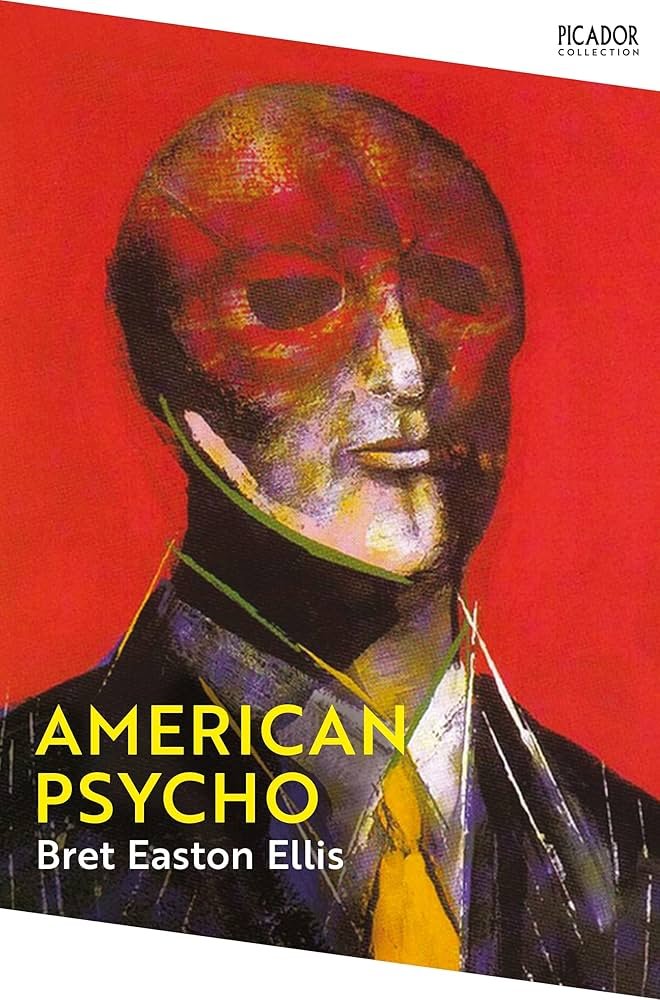
American Psycho – Bret Easton Ellis
Patrick Bateman has it all: good looks, youth, charm, a job on Wall Street, and reservations at every new restaurant in town. He is also a psychopath. A man addicted to his superficial, perfect life, he pulls us into a dark underworld where the American Dream becomes a nightmare . . .
📌 TL;DR
A shocking, satirical, and deliberately repulsive dive into consumerism, violence, and the emptiness of 1980s Wall Street culture.
💥 Hook
“I need to return some video tapes.”
💬 The Big Idea
What lingers is the hollowness. Behind the suits, the restaurants, the business cards, and the violence, there’s nothing — no identity, no morality, no meaning. Just a void dressed in Armani.
🧠 What’s it About?
Patrick Bateman, a wealthy Wall Street investment banker, narrates his daily life of excess, obsession with brands, and increasingly graphic violence. The novel blends satire with horror, leaving the reader questioning what’s real and what’s imagined.
🔍 Why It’s More Than Just the Blurb
Yes, it’s about a serial killer. But more importantly, it’s about a culture obsessed with appearances and status, where human life has no value beyond surface aesthetics. Bateman is less a person than a mirror of a society rotting from the inside.
🔍 Deep Dive
Ellis uses detached, clinical prose and endless detail about brands, restaurants, and routines to numb the reader — until sudden bursts of violence jolt us awake. The repetition becomes the point: Bateman and his peers are interchangeable, shallow, and morally bankrupt. The novel’s racism, sexism, and homophobia are not side notes but central to the critique, showing how cruelty and prejudice seep through elite culture. At the same time, it’s worth acknowledging the discomfort that comes with Ellis — a white male author — putting slurs and demeaning stereotypes directly on the page. For some, this bluntness strengthens the satire, exposing the ugliness of the world Bateman inhabits; for others, it feels gratuitous, a case of reproducing harm in the name of critique. That tension is part of what has kept American Psycho so divisive: it forces readers to wrestle with whether Ellis is successfully critiquing the culture, or inadvertently complicit in it.
📚 What’s Inside? (Spoiler-Free Breakdown)
- A chillingly detached first-person narration
- Graphic, shocking violence contrasted with obsessive detail about fashion, music, and food
- A biting satire of 1980s consumerism and Wall Street culture
- An unreliable narrator whose reality may be unraveling
- A deliberately provocative exploration of misogyny, racism, and homophobia in a world that rewards surface over substance
Full Review By Jasmine
★ ★ ★ ★ ☆
American Psycho is one of the most disturbing books I’ve ever read — and that’s exactly the point. Bret Easton Ellis writes with a detached, almost clinical precision that makes Patrick Bateman’s world of designer brands and serial violence feel eerily normal, until it suddenly doesn’t. The opening chapters lull you into the monotony of Wall Street excess, with Bateman obsessing over business cards, skincare routines, and the right restaurant reservations. He spends pages cataloguing clothing labels and high-end products, all in an effort to prove that he’s sharper, richer, and more refined than everyone else.
What makes Bateman so fascinating as a character is how pretentious and painfully performative he is. His conversations are littered with obvious, almost embarrassing lies that no one around him calls out, making him seem both powerful and pathetic at once. He wants desperately to be seen as superior, yet the more he talks, the more transparent his insecurities become. That mix — shallow, self-important, and cringingly artificial — makes him one of the best-written “unreliable narrators” in modern literature.
Ellis also uses Bateman as a grotesque caricature of 1980s American masculinity. He is competitive to the point of absurdity, constantly measuring himself against other men — whose suits are better cut, whose business cards are more impressive, who has access to the best restaurants. His aggression, his misogyny, his racism, and his obsession with dominance all reflect a version of manhood that is at once celebrated and hollow. Bateman doesn’t just embody toxic masculinity — he exposes it as fundamentally insecure, built on fragile hierarchies of power, wealth, and appearance.
Then, without warning, the tone shifts into horrifying violence — so graphic and relentless that you’re left reeling.
This constant oscillation between numb banality and grotesque horror is what makes the novel so effective as satire. Bateman’s world is obsessed with surfaces — what suit you wear, where you eat, what music you like — yet beneath it all, there’s a terrifying emptiness. The racism, sexism, and homophobia threaded throughout the narrative are shocking, but they’re also revealing: Bateman’s cruelty isn’t just personal, it reflects a culture built on exclusion, prejudice, and dehumanisation.
It’s not an easy book to read, and it’s not meant to be. The violence is intentionally excessive, forcing the reader to confront their own tolerance for consuming horror as entertainment. At times, I found myself questioning why I kept turning the pages — but that discomfort is part of what makes the book work. It’s less about whether Bateman “really” did the things he describes and more about the world that allows a character like him to exist unquestioned.
For me, American Psycho is a four-star read. Not because it’s enjoyable in any traditional sense, but because it succeeds so well at what it sets out to do: unsettle, disturb, and hold up a mirror to a culture obsessed with wealth, masculinity, and appearances — even if what we see in the reflection is monstrous.
🎭 Mood & Matchmaker
Bleak, shocking, satirical, and deeply disturbing. Not for the faint of heart, but for readers of transgressive fiction who can handle extremes.
🌈 Vibes Check
What kind of vibe are you in for? Let’s break it down:
✍️ Writing Style: Detached, clinical, repetitive, ironic
🩸 Horror Level: Extreme, graphic, deeply unsettling
🚫 Social Climate: Explicitly racist, sexist, and homophobic — part of the critique
💼 Capitalism Critique: Central and relentless
🧠 Emotional Range: Cold, numbing, grotesque, darkly funny in places
🔄 Mood Matches
If you liked…
- Fight Club by Chuck Palahniuk (nihilism + consumer culture critique)
- Crash by J.G. Ballard (graphic, transgressive, surreal detachment)
- Less Than Zero by Bret Easton Ellis (similar detached, decadent world)
🖤 Fascinated by American Psycho?
Explore more dark, psychological thrillers and twisted tales in our curated lists and reviews.
🧃 Emotional Map
🤢 Disturbed/repulsed — 10/10
😐 Emotional numbness — 9/10
😂 Dark satire — 6/10
🧠 Stays with you afterwards — 8/10
🎯 For the Right Reader
If you’re drawn to transgressive fiction that pushes boundaries, critiques consumer culture, and makes you question the line between satire and horror, this is for you.
📦 Who Will Love This?
- Fans of dark satire and postmodern fiction
- Readers interested in social critique of 1980s Wall Street excess
- Those who don’t shy away from graphic, disturbing content
🧭 Where I Found It
After watching the American Psycho film (starring Christian Bale), I was really intrigued by the story and wanted to read the book.
💡 Extra Curiosities
Got some quick questions about American Psycho? Here are a few things readers often wonder:
Is American Psycho a tough read?
Yes — American Psycho is notoriously difficult to read. The prose itself is straightforward, but the novel is filled with extreme, graphic violence, alongside depictions of racism, sexism, and homophobia. This deliberate brutality, combined with Patrick Bateman’s detached narration, makes the book emotionally and psychologically challenging rather than simply complex in style.
Is the American Psycho book different than the movie?
Yes. While the 2000 film adaptation captures the satirical edge and core story line, it tones down the most graphic violence and disturbing content from the book. The novel is far more explicit, repetitive, and ambiguous, especially about whether Bateman’s crimes are real or imagined. Readers often find the book darker, more unsettling, and more focused on consumerist detail than the film.
Is American Psycho satire book?
Yes. Beneath its shocking violence, American Psycho is a biting satire of 1980s Wall Street culture. Bret Easton Ellis critiques consumerism, materialism, toxic masculinity, and the emptiness of a society obsessed with status and appearance. The violence works hand in hand with the satire, forcing readers to confront the dehumanisation at the heart of Bateman’s world.
👋 Final Thoughts
American Psycho is a novel that leaves a lasting impression, whether through its extreme violence, satirical eye on consumer culture, or the unsettling portrait of Patrick Bateman himself. It’s a challenging, provocative read that forces readers to confront the darker aspects of wealth, masculinity, and social obsession with appearances. While it’s not an easy book, its unflinching critique and sharp, detached style make it a work that resonates far beyond the final page.